












What Tools Are Needed for Timing Belt Replacement?


You’ll need precise torque wrenches—3/8 inch for main bolts and 1/4 inch for smaller ones—and angle gauges to prevent over-tightening.
Prepare specific sockets: 24 mm for VVT sprockets, 27 mm thin offset for tight spots, and 32 mm for tensioners.
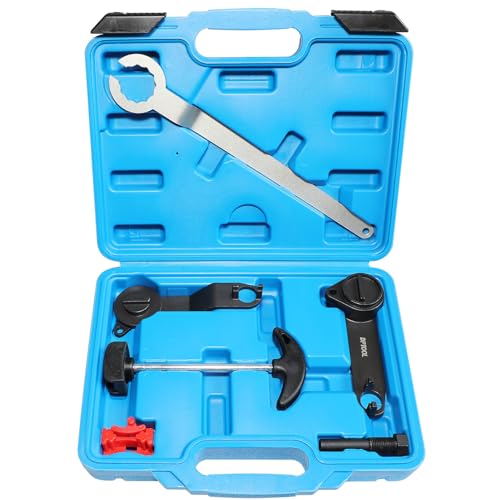
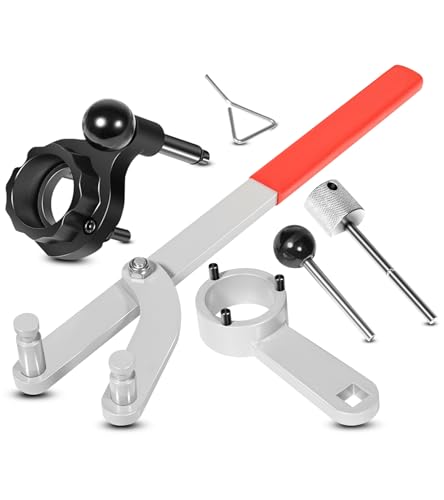
Specialized tools like a crank pulley holder and cam sprocket lock guarantee accurate timing alignment.
Organize your workspace with these tools plus breaker bars and retaining pins for efficient, damage-free installation.
Keep going to understand each tool’s exact role and setup tips.
 Recommended Timing Belt Replacement Intervals Explained
Table
- Main Points
- Essential Torque Wrenches and Angle Gauges
- Socket and Wrench Sizes for Timing Belt Components
- Specialized Tools for Crankshaft and Camshaft Work
- Organizing and Preparing Tools for Efficient Replacement
- Tips for Successful Timing Belt Installation
- Frequently Asked Questions
- Final Thoughts
Main Points
- Use 3/8 and 1/4 torque wrenches for accurate torque application on timing belt components.
- Employ a 27 mm thin offset wrench and 24 mm socket for sprocket bolts in tight spaces.
- Utilize a crank pulley holder and breaker bar to prevent engine rotation and loosen stubborn bolts.
- Lock camshafts with a cam sprocket tool and secure hydraulic tensioners with retaining pins during installation.
- Organize tools and bolts systematically, and use an angle gauge to measure rotation angles precisely.
Essential Torque Wrenches and Angle Gauges

When replacing a timing belt, you’ll need both a 3/8 and a 1/4 torque wrench to apply the correct torque to various components, ensuring they meet manufacturer specifications precisely. The 3/8 torque wrench is ideal for primary timing belt components, while the 1/4 torque wrench handles smaller bolts with equal accuracy. To achieve exact torque values given in degrees, angle gauges become indispensable, measuring rotation angles and preventing over-tightening. Before final tightening, use a breaker bar to loosen stubborn bolts safely without damaging threads or seals. Employing these tools during your timing belt change guarantees precise torque application, protecting seals and bearings while adhering strictly to manufacturer specifications. This precision liberates you from premature component failure, ensuring your timing belts function reliably and your engine runs smoothly. For optimal results and accuracy, consider using a dual-direction adjustable click torque wrench that provides both audible and tactile feedback to prevent over-tightening during installation.
Socket and Wrench Sizes for Timing Belt Components

Although timing belt replacement involves various components, selecting the correct socket and wrench sizes is critical for efficient and damage-free removal. Using the right timing tools guarantees you can access tight spots and apply proper torque without stripping bolts or damaging parts. The 27 mm thin offset wrench is indispensable for confined areas, while the 24 mm socket fits VVT sprocket bolts precisely. The 32 mm socket handles the timing chain tensioner, and a breaker bar provides leverage on stubborn fasteners. Complement these with 1/4 inch and 3/8 inch torque wrenches to meet exact torque specs.
- 27 mm thin offset wrench for tight spaces
- 24 mm socket for VVT sprocket bolts
- 32 mm socket for timing chain tensioner
- Breaker bar to loosen tight bolts
Master these tools to liberate your timing work.
Specialized Tools for Crankshaft and Camshaft Work

Mastering the correct socket and wrench sizes sets the foundation for effective timing belt replacement, but specialized tools specifically designed for the crankshaft and camshaft elevate your control and accuracy during the process. A crank pulley holder prevents engine rotation while loosening the crankshaft bolt, essential for maintaining alignment. Use a breaker bar to apply sufficient leverage on stubborn crankshaft bolts, overcoming their high torque settings. The cam sprocket tool locks the camshaft in place, guaranteeing precise alignment of timing marks during belt installation. Retaining pins secure spring-loaded hydraulic tensioners in a relaxed position, facilitating safer, more efficient work. Employ exact socket sizes—like 24mm for VVT sprocket bolts and 32mm for timing chain tensioners—to avoid damage and guarantee smooth removal and installation. These specialized tools grant you mastery over crankshaft and camshaft components. Just as you would distribute weight evenly when jacking up a floor from a crawl space, using the right tools for crankshaft and camshaft work ensures even, controlled force and prevents accidental damage during timing belt replacement.
Organizing and Preparing Tools for Efficient Replacement

Before you begin the timing belt replacement, gather all necessary tools, including a thin 27 mm offset wrench, flywheel lock, torque wrench, crank pulley holder, and breaker bar with a cheater pipe. Knowing exactly which tools do I need guarantees you won't interrupt your workflow. Organize your workspace meticulously to streamline the process and prevent loss of components. Use the crank pulley holder and flywheel lock to stop the engine from rotating during bolt removal. Incorporate a timing belt kit with a water pump and consider adding a cam sprocket tool to maintain timing integrity. Remember, a well-prepared space and correct toolset empower you to execute the replacement efficiently and precisely.
- Label and sort bolts and screws systematically
- Verify all tools, including thin wrench and torque wrench, are in good condition
- Arrange the timing belt kit and cam sprocket tool within easy reach
- Secure engine components from unwanted rotation before disassembly
Tips for Successful Timing Belt Installation

Having your tools organized and engine components securely immobilized sets the stage for a precise timing belt installation. Begin by aligning the timing marks to top dead center following OE specifications; this alignment is critical to engine performance. Use touch-up paint on timing marks to enhance visibility during installation. Remove spark plugs to ease manual rotation, helping you verify timing mark alignment accurately. Employ a timing belt kit that includes a water pump, since replacing both prevents future failures. Throughout disassembly, document removal meticulously—label parts and bolts clearly—to guarantee seamless reassembly without oversight. Using the right tools for immobilization and alignment, you maintain control throughout the process, assuring the timing belt and water pump install flawlessly, freeing you from guesswork and securing engine reliability.
 Warning Signs Your Car’s Timing Belt Is Failing
Frequently Asked Questions
Can I Replace My Timing Belt Myself?
You can tackle DIY timing replacement if you spot signs of wear or timing belt issues affecting engine performance. Understanding tools for maintenance and timing belt lifespan helps reduce the cost of replacement and guarantees reliable operation.
What Tools Do You Need to Change a Belt on a Car?
You’ll need essential automotive tools like a torque wrench, offset wrench, and flywheel lock for the timing belt tools kit. Master these to avoid common mistakes, streamline the belt replacement process, and save on DIY car repairs costs.
Do You Need Special Tools to Replace a Timing Chain?
Don’t think timing chain maintenance is simple—you’ll need special tool requirements like cam sprocket tools to avoid common replacement mistakes. DIY replacement tips help, but professional assistance benefits guarantee engine performance impact and timing chain longevity aren’t compromised.
Is Replacing the Timing Belt Easy?
You’ll find timing belt complexity varies; with diligent DIY automotive repairs, addressing common timing issues can save belt replacement costs. Yet, professional mechanic advice guarantees engine performance impact is minimal—follow maintenance scheduling tips for reliability and freedom.
Final Thoughts
Replacing a timing belt is like conducting a symphony—each tool plays an essential role. You'll need precise torque wrenches, correct socket sizes, and specialized crankshaft and camshaft tools to guarantee everything aligns perfectly. Organizing your tools beforehand streamlines the process, preventing costly errors. By following these detailed steps and using the right equipment, you’ll achieve a reliable, accurate installation that keeps your engine running smoothly and efficiently.
 What Is the Average Labor Time for Timing Belt Replacement?
Reliable Floor Jacks on a Budget: Best Picks for Under $150
Top-Rated Floor Jacks Over $100: Built for Professionals, Priced for Smart Buyers
If you want to know other articles similar to What Tools Are Needed for Timing Belt Replacement? you can visit the Timing Belt Care and Replacement category.
Warning Signs Your Car’s Timing Belt Is Failing

Recommended Timing Belt Replacement Intervals Explained

Timing Belt Vs Timing Chain: 5 Key Differences

How to Tell If Your Timing Belt Needs Replacement

Consequences of a Broken Timing Belt Explained

Why Does Timing Belt Replacement Cost Vary?

What Are the Top Shops for Timing Belt Replacement?

Why Replace Your Toyota Camry Timing Belt?
Leave a Reply
This is also interesting